About Kat:
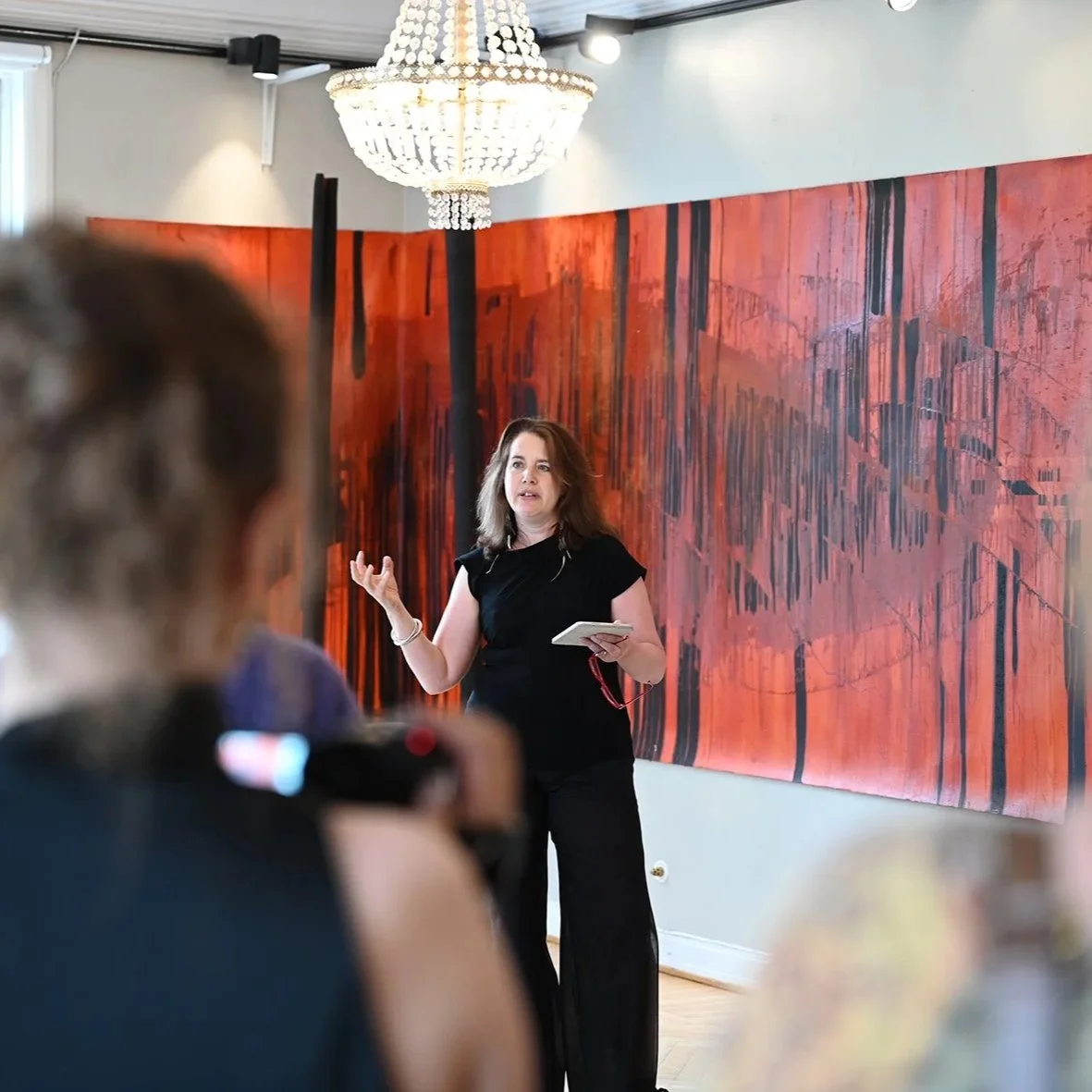
Katie Hagen (Kat), neé Mather
Visual Artist & Chartered Architect
Educated at Edinburgh College of Art, Heriot Watt University, Scotland (1991-1997) Kat’s background is as both a Chartered Architect and Visual Artist. Kat’s art practice is predominantly painting-based and expands into sculpture, site-specific installation and drawing.
Artist Statement:
Artist as a way of being
My artistic drive is led by an innate desire to learn about myself, my connection to the world and relationships to others. I explore contradictions between lasting transformation and ephemerality witnessed in the fragility of life and the space left by someone - a Being - once they are gone. Grief (love) in all its nuances is a recurring theme connecting my works, both past and present.
I allow my works the freedom to evolve intuitively while simultaneously being intentional regarding the materials I use. They can be regarded as living sculptures that change over time in dialog with each other and in response to the physical spaces in which they are presented. I enjoy both the metaphorical power and the literal connection to place and matter that a specific rock, pigment or element can bring to work. Fire from deep within the Earth, ‘captured’ and frozen in time, my use of basalt in some of my earlier works alludes to the lava fields and black volcanic beaches of Iceland. The fire suggesting a human presence dating back to prehistoric times rests in the burnt remains of Bone Black in my current works.
My fascination with fire is rooted in its ability to bring about change and transformation, both in the physical world and our inner selves. Our relationship to it is primal and deep, carried within us across generations. Fire can gather, nurture and protect, however, it can also destroy, consume, overwhelm. Beyond its destructive act, fire also brings forth creation, turning bones and trees into artists’ pigments and mark making tools.
Ochres (“Iron Earths”) are consistently present throughout the cultural records of humanity and could suggest a deep permanence and embodied wisdom, and my use of them could seem contradictory, almost out of place to the idea of impermanence, burnt remains and our ephemerality. Yet, both are intrinsically linked to us, our humanity, our psyche.
There is something about being able to connect my current use of “Iron Earths” to both our bodies here on Earth and the stars of the cosmos that intrigues me. I am fascinated by the connection between the microscopic and the universal - between our bodies and the cosmos. Astrophysicist Freeman Dyson wrote about how all matter eventually breaks down into iron. I like the idea that the same element is found in both us and the stars. It gives me a sense of connection and humility.
Member of NBF & NBK
(Norwegian Sculptors Society & National Association of Norwegian Visual Artists)
Member of BONO
(The Norwegian Visual Artists Copyright Society)
Former member of both RIBA & MNAL
(The Royal Institute of British Architects & The National Association of Norwegian Architects)
Based in Norway - Rjukan : Oslo
Tel: +47 92281724 Email : kat@kat-art.no